
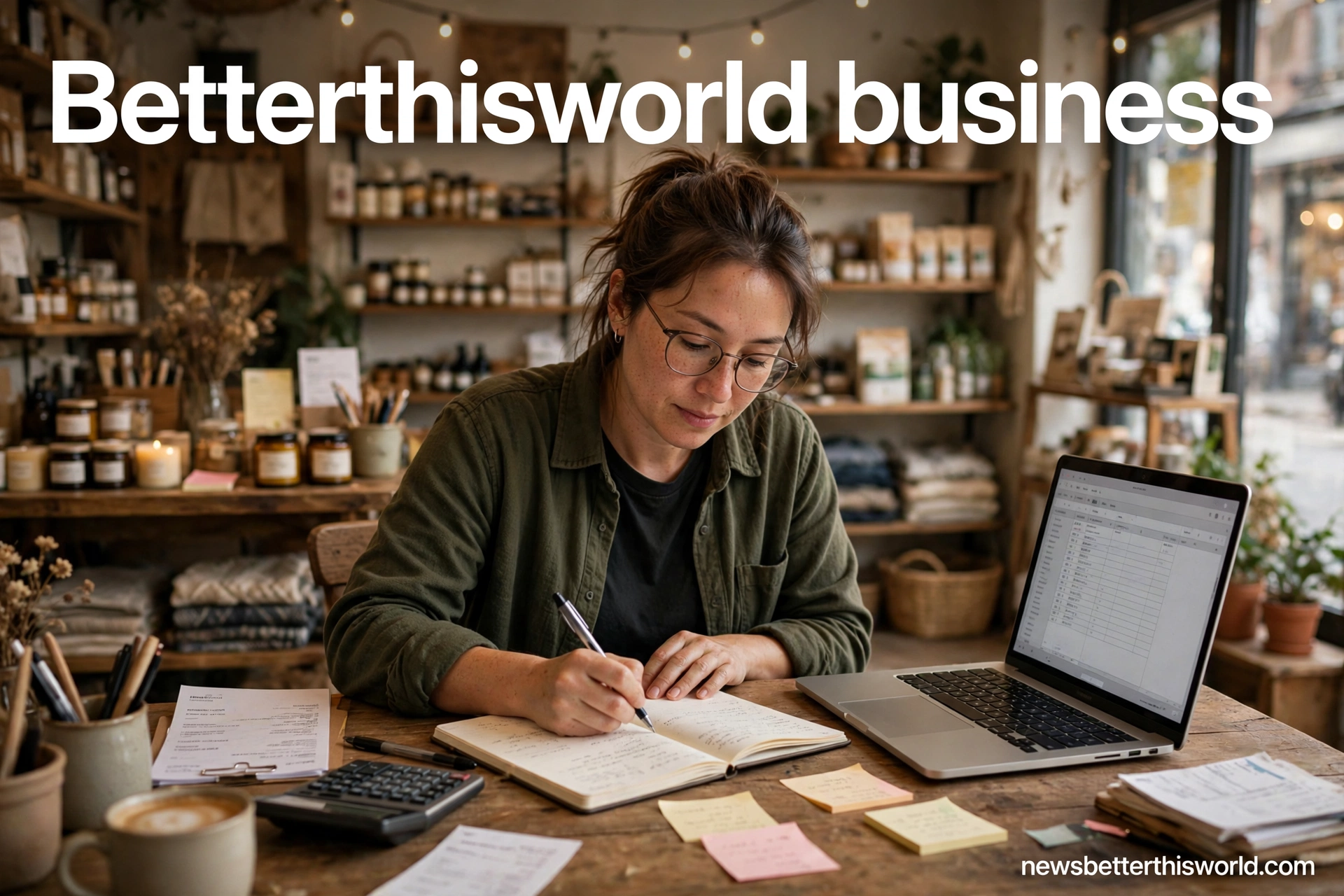
Starting a business is less about a perfect launch and more about a clear customer, a useful offer, a fair price, and honest numbers. In this guide, betterthisworld business means practical, plain-language help for founders, freelancers, and small teams who want to test an idea carefully, find their first paying customers, and grow steadily without losing quality.
Key takeaways
- Start with one specific customer and one clear problem, not “everyone.”
- Test the idea in a small, paid way before spending much.
- Choose a simple business model you can explain in one sentence.
- A fair price must cover costs, time, and a small margin.
- Cash flow is about timing: profit on paper is not cash in the bank.
- Keep business and personal money separate, with simple records from the first sale.
- Grow one improvement at a time, guided by returning customers.
What does betterthisworld business mean for a new founder?
The phrase betterthisworld business points to business content that is practical rather than glamorous: a clear customer, a useful offer, a fair price, and learning from real feedback. Slow growth with happy customers is often stronger than fast growth, because happy customers return, recommend the business, and tell the founder what to improve next.
There is no single right kind of business. Some sell a service, such as writing, cleaning, tutoring, or bookkeeping. Others sell a product, such as food, clothing, or handmade goods. Some work locally, while others work online. The questions stay the same: who is this for, what problem does it solve, and how will it earn money?
A hobby is something you enjoy doing. A business is something a customer will pay for, more than once, at a price that covers costs and time. That means a clear offer, a price, a way to take payment, and a way to follow up. A side project sits between the two, and it becomes a business when the founder gives it regular hours and clear records.
Who is the customer, really?
Every business serves someone specific. “Everyone” is not a customer. A founder should be able to describe one typical customer: what they do, what they struggle with, and where they look for help. Write the idea in two sentences: who the customer is, and what result they get. For example: “I help busy parents with weekly home-cooked meals. They save cooking time.”
What does a good offer look like?
A good offer is easy to understand in a few seconds. It names the result, who it is for, what is included, and what it costs. “I do business services” is vague. “I help small shops with monthly bookkeeping, including invoices and a simple monthly summary, for a fixed monthly fee” is clear. A clear offer also sets a boundary: what is included, what is not, and how long the work takes.
How do you choose a business model?
A business model is simply how a business earns money and delivers its offer. The founder should be able to explain it in one sentence, such as: “Customers pay a monthly fee for a regular service.” Keeping that model simple is a core part of betterthisworld business thinking. A one-off sale needs new customers often, while a regular service needs reliable delivery every time.
| Business model | How it earns money | Best suited to | Main challenge |
|---|---|---|---|
| One-off product sale | One item, bought once | Shops, makers, food sellers | Needs new buyers regularly |
| One-off service | One job, paid once | Repairs, design, cleaning, tutoring | Income can vary month to month |
| Regular service or retainer | Monthly payment for ongoing help | Bookkeeping, maintenance, coaching | Delivery must stay reliable |
| Subscription or membership | Regular payment for access or deliveries | Boxes, lessons, online content | Customers expect fresh value |
| Custom project work | Payment for a defined project | Freelance writing, building, consulting | Needs clear briefs and payment terms |
Many small businesses mix two models. A tutor might sell single lessons and a monthly package. A baker might sell single cakes and a weekly order for a cafe. Mixing models is fine, as long as each one has a clear price and a clear promise.
How do you test a business idea before spending much money?
Do not spend a lot on a website, stock, or advertising before knowing whether anyone wants the offer. Offer a simple version first, to a small group. The test should answer three questions: will people pay, will they come back, and what should change? A service business can test with a few paid trial clients, a product business with a small batch or pre-order, and an online business with one clear page. That small-test habit is at the heart of betterthisworld business.
Feedback from a test is more useful than praise from friends. Paying customers show what they truly value by what they buy and whether they return. If people ask the same question again and again, something in the offer is unclear. Keep notes during the test: the questions people ask and the parts customers praise.
A simple test plan
- Write the offer in two sentences, with the customer and the result.
- Choose ten people who match that customer, and tell them about the offer.
- Offer a simple paid version, with a clear price and a clear end date.
- Deliver it well, then ask each customer what worked and what they would change.
- Decide: keep the offer, change one part of it, or stop and try a different idea.
How do you read test results honestly?
Look at behaviour, not only words. A customer who says “this is lovely” but does not buy is giving a different signal from one who buys, returns, and recommends the business. Set a simple rule before the test: if at least a few of the ten people pay and at least one returns, the idea is worth improving. If nobody pays, the offer, the price, or the customer may need to change.
How do you find and understand customers?
A business does not need thousands of followers to start. It needs a small number of people who trust it. The first customers often come from people the founder already knows, a simple online listing, a local notice, or a recommendation from a happy customer. When someone asks, “What do you do?”, the answer should be short and specific: “I help small shops with monthly bookkeeping” is clearer than “I do business services.” Be easy to contact and easy to buy from. The BetterThisWorld homepage brings together the site’s guides, and a business page should be just as simple.
Be easy to contact and easy to buy from. A simple page with the offer, the price, and how to order can make a real difference. Follow up with early customers: a short message after delivery often leads to useful feedback or a repeat order.
How do you ask customers useful questions?
Ask short, open questions after a sale, such as: “What made you choose this?”, “What was easiest about ordering?”, and “What would make you come back?” Write down the answers in the customer’s own words. Avoid leading questions such as “You loved it, didn’t you?” Those produce polite answers, not useful ones. Listening this way is a simple betterthisworld business habit: let customers shape the offer.
Money basics: pricing, costs and cash flow
Money is where many new businesses struggle, not because the founder is careless, but because the numbers were never written down. A simple money plan needs a clear list of costs, a clear price, and a regular check on what is coming in and going out. Getting those basics right is central to betterthisworld business: honest numbers, written down and reviewed often.
How to choose a price
There are three common ways to think about price, and a founder can use all three together:
| Pricing approach | How it works | Watch out for |
|---|---|---|
| Cost-based pricing | Add up costs and time, then add a margin | May ignore customer expectations |
| Customer-based pricing | Price around the value received | Needs honest feedback |
| Competitor-based pricing | Compare with similar options | A competitor may have lower costs |
Start with costs, so the lowest workable price is clear. Then look at what similar options charge, and what customers say they expect. Review the price when costs rise or when the offer improves. Do not copy a competitor’s price without understanding why they charge it. Pricing too low is a common mistake: it leaves no room for a quiet month, a mistake, or the time spent on messages and follow-up.
Cash flow is not the same as profit
Cash flow is different from profit. Profit is income minus costs over a period; cash flow is money coming in and going out at a particular time. A business can be profitable on paper and still run out of cash if customers pay late, or if a large cost arrives before the income does. Ask for a deposit for larger work, send invoices promptly, and agree on payment terms before the work starts. Keep a small reserve, so one slow month is not a crisis, and keep business cash and personal cash separate. The guide to betterthisworld money explains budgeting, saving, and planning in plain language.
How do you keep records without a complicated system?
Records do not need fancy software at the start. They need to be complete, regular, and easy to find. A simple spreadsheet, a notebook used every week, or a basic accounting app can all work, as long as the founder uses the same system every time. Record every sale and every cost, with the date, the customer or supplier, what was sold or bought, and how it was paid. Keep receipts and invoices in one place. Good records show whether the business is earning or losing money and reveal patterns, such as which months are quiet. Tax rules differ by country, so check the rules where you live.
A simple monthly money routine
- Record all income and spending in one place each week.
- Compare the month with the plan: what sold well, and what cost more?
- Set aside money for tax and for quiet months first.
- Review prices when costs rise.
- Keep a small reserve, so one slow month is not a crisis.
- Check which customers still owe payment, and follow up politely and promptly.
How do you market a small business without a big budget?
Marketing, for a small business, is simply helping the right people understand the offer, trust the business, and know how to buy. It does not need a large budget, only a clear message, repeated where customers already look. Start with the basics: a clear name, a short description of the offer, a way to contact the business, and a simple page where customers can see the price and how to order. Word of mouth is often the strongest marketing for a small business, because a recommendation from a real customer carries trust.
How do you run day-to-day operations smoothly?
Operations are the daily habits that keep a business running: answering messages, preparing orders, keeping stock tidy, delivering on time, and following up. Write down the steps for the most common tasks: how an order arrives, how it is confirmed, how it is prepared and delivered, and what happens if a customer changes the time or asks for a refund. Keep one place for customer details, one place for orders, and one place for money. If something goes wrong, listen, apologise simply, explain what happens next, and follow through. The guide to betterthisworld tech explains the simple tools a small business can use to stay organised, and the guide to betterthisworld technical guides covers practical how-to steps for using them well.
How do you work well with a small team?
Many founders start alone, then add help when the work grows. The first helper might pack orders, answer messages, keep records, or help with deliveries. Before hiring, write down the task, how it should be done, and how the founder will check it. Start with one clear task, so the founder can focus on the work only they can do. For a small team, write down who does what, when it is due, and how the team will check the work. A short weekly check-in can prevent misunderstandings.
Business ideas and the problems they solve
| Business type | Main customer need | What to test first | Common risk |
|---|---|---|---|
| Service business | A task done well and on time | A few paid trial clients | Limited time; growth needs help or higher prices |
| Product business | A useful item at a fair price | A small batch or pre-order | Stock costs money before sales arrive |
| Local business | Convenience and trust nearby | A simple local offer and clear hours | Quiet seasons and local competition |
| Online business | Clear information and easy ordering | One clear page and a simple way to order | Customers cannot see the product before buying |
| Freelance work | Skill for a specific project | A small paid project with a clear brief | Income can be uneven from month to month |
This table is a starting point, not a verdict. Many businesses mix these types: a tutor might work locally and online, and a maker might sell at a market and through a simple online page. The test is the same: does a real customer pay, return, and recommend the business?
How do you grow without losing quality?
Growth is a different skill from starting. Starting is about proving the idea. Growing is about repeating what works and improving one part at a time, while keeping customers happy. A business that grows too fast, without the systems to support it, can lose the quality that made customers trust it in the first place. That is betterthisworld business in practice: repeat what works, and improve one part at a time. Track new customers, returning customers, and which months are quiet, with a simple weekly note. The guide to betterthisworld stocks explains investing basics, including risk and patience, and it is a useful reminder that steady, patient growth often beats rushing.
When is the right time to grow?
Grow when the core offer works, customers return, and the numbers are clear. That means the founder knows what sells, what it costs, and how much time each sale takes. Signs that growth may be ready include regular repeat orders and customers asking for more than the founder can supply alone. Signs that growth is too soon include frequent mistakes, late deliveries, and a founder who is already exhausted.
How can business news help a small founder?
Business news can help a founder notice changes that affect customers, costs, and demand, such as new rules, rising prices for supplies, or changing habits in how people shop and work. A founder does not need to follow every story, only the few changes that touch their own customers and costs, and that kind of practical reading is part of betterthisworld business too. Read news with a practical question in mind: does this change what my customers need, what my supplies cost, or how I should explain my offer? The guide to news betterthisworld brings together the site’s news and guides.
A simple planning routine for founders and small teams
A plan does not need to be long. A one-page plan, reviewed regularly, is often more useful than a long document that is never opened. The point of planning is to make the next step clear, not to predict everything. That steady routine is the heart of betterthisworld business. Start with the customer and the offer, and check whether the two-sentence description is still true. Then write down the goal for the next month in plain words, list the three tasks that matter most, and put them in order. At the end of the month, review what worked, what cost more than expected, and what customers said. The guide to betterthisfacts tips from betterthisworld offers practical tips in the same plain style, and the guide to betterthisworld success looks at goals, habits, and steady progress.
Common mistakes to avoid
New founders often make the same few mistakes: trying to serve everyone, pricing too low to survive, spending on extras before the core offer is proven, ignoring the numbers, and doing everything alone for too long. Trying to serve everyone leads to a vague offer. Pricing too low leaves no room for a quiet month or a mistake. Spending on extras before the offer is proven ties up money that could have been used for a test. Another mistake is copying a competitor without understanding why they succeed: a competitor may have lower prices because they have lower costs. Finally, many founders forget to rest. A business needs a founder who can think clearly, and that is hard when the founder is exhausted. The guide to betterthisworld health covers simple habits that support steady energy and clear thinking. For general guidance, the U.S. Small Business Administration offers plain-language guides at sba.gov.
Frequently asked questions
What is the first step in starting a business?
Describe the customer and the problem in two sentences, then talk to a few real people who have that problem. If they would pay for a solution, test the idea in a small way first.
How much money do I need to start?
It depends on the business. A service business can start with very little, because the main cost is time. A product business needs money for stock and materials. Start small and keep a simple list of costs.
How do I choose a price?
Add up the costs, including time, then compare with what customers expect to pay and what similar options charge. Choose a price that covers costs and leaves a small margin.
How do I find my first customers?
Start with people you already know, a local community, or a simple page that explains the offer, the price, and how to order. Follow up after the first sale, and ask happy customers for a recommendation.
How do I test an idea without spending much money?
Offer a simple paid version to a small group, such as a few trial clients, a small batch, or a pre-order. Ask what worked and what should change, then decide whether to keep the offer, change one part, or try a different idea.
What is the difference between cash flow and profit?
Profit is income minus costs over a period. Cash flow is money coming in and going out at a particular time. A business can be profitable on paper and still run out of cash if customers pay late.
When should a business grow?
Grow when the core offer works, customers return, and the numbers are clear. Improve one part at a time, and hire help only when the founder’s time limits serving customers well.
Should I keep business money and personal money separate?
Yes. Use one place to record business income and spending, so you can see clearly what the business earns, what it costs, and whether it can cover its own expenses.
What if a customer is unhappy?
Listen first, apologise simply if something went wrong, explain what will happen next, and follow through. Keep a note of the problem, so the same pattern can be prevented next time.
Is this guide financial advice?
No. This guide is educational only. For tax, legal, or investing decisions, consider speaking to a qualified adviser in your own country.
Conclusion
Betterthisworld business is not about a perfect launch. It is about a clear customer, a useful offer, a fair price, honest numbers, and steady improvement. Test small, listen to paying customers, keep simple records, and grow one improvement at a time. A business built that way may grow slowly, but it grows on trust, and trust is what brings customers back.
Disclaimer: This article is for general information and education only. It is not financial, legal or business advice. Verify important details from primary sources before acting on them, and seek qualified professional advice where appropriate.