
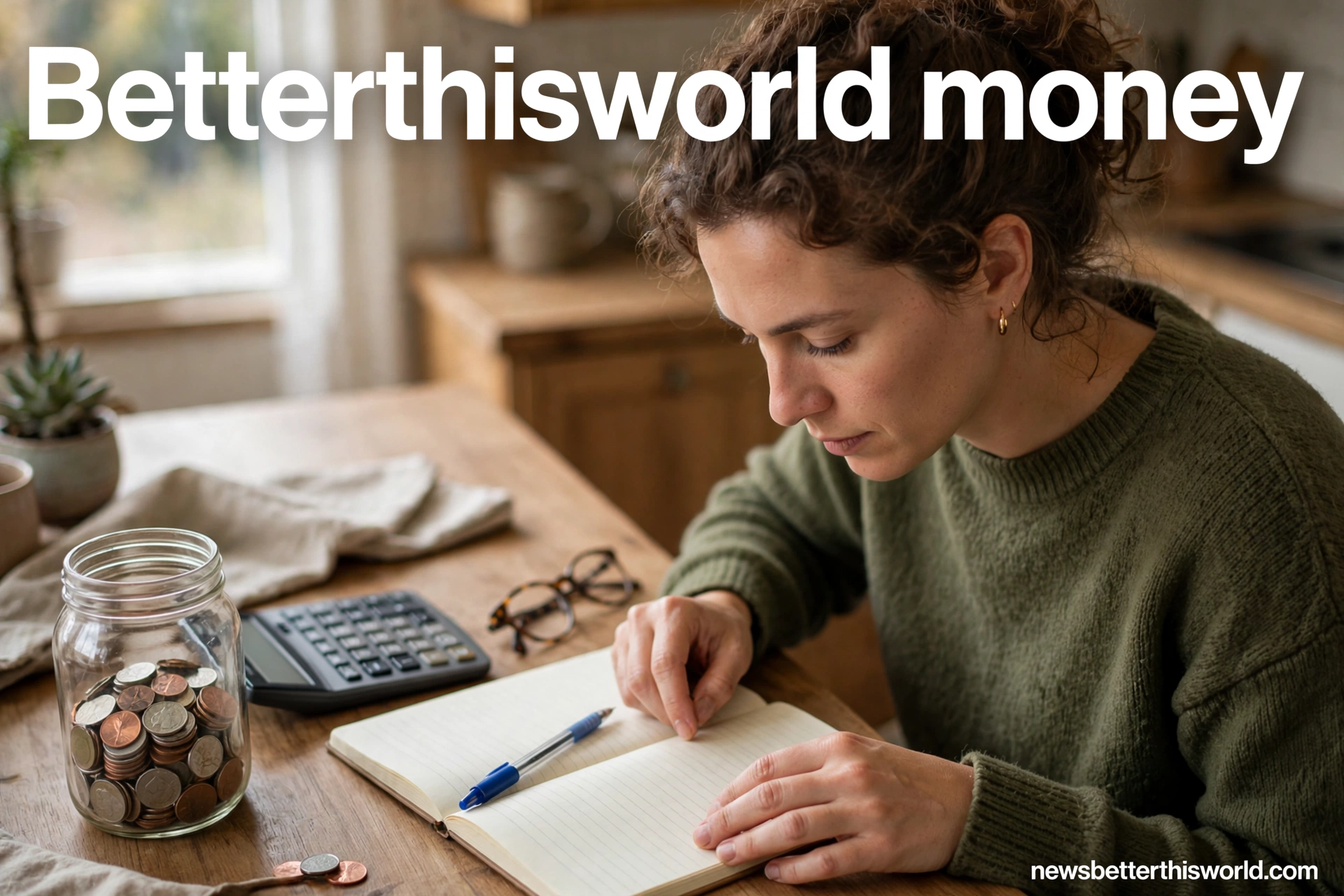
Betterthisworld money means managing everyday money in plain language: track what comes in and goes out, give every amount a purpose before the month begins, save a small fixed amount first, build a cushion for surprises, and deal with expensive debt step by step. This guide explains that routine without jargon or promises of quick wealth.
Key takeaways
- Decide where money goes before the month begins.
- Track spending for one full month before cutting anything.
- Save a small fixed amount on payday; regularity matters more than size.
- Build a small emergency cushion first, then tackle the highest-interest debt.
- Separate essentials, flexible spending and money for the future, and review monthly.
- Keep personal and business money separate, even for a very small business.
- A simple plan you review beats a perfect plan you abandon.
What does this guide cover?
Betterthisworld money covers everyday questions most readers face. How do I make a salary last the month? How do I start saving when money feels tight? How do I deal with debt without panic? Work in order: first understand where money goes now, then build a small cushion, then deal with expensive debt, and only then think about longer-term goals.
That order matters. Saving while paying very high card interest can lose more than it gains, and a long-term plan without a cushion can mean needing the money back at the wrong time.
The phrase money betterthisworld is another way readers search for the same topic, and the method is the same. It also covers needs versus wants, budgeting methods, planning for a goal, coping when income changes, and reading money news without letting a headline change a sensible plan.
How do I start by tracking, not by judging?
The first step is not to cut spending. It is to notice spending. For one month, write down everything spent, in a notebook, a spreadsheet, or a notes app, including small amounts, cash purchases and subscriptions. Do not judge the list; the point is to see the truth. That is the starting point for betterthisworld money: facts first, cuts second.
At the end of the month, divide spending into three groups: essentials such as housing, basic food, transport and bills; flexible spending such as eating out and small purchases; and money for the future, such as saving and extra debt payments. Most people are surprised by the flexible group, because small purchases add up.
A step-by-step way to track spending
- Pick one tool and stick to it. A notebook, notes app or spreadsheet all work.
- Record spending the same day. Write the amount, what it was for, and whether it was cash or card.
- Note the reason, not just the amount. A word such as “lunch” or “bus” makes the review far more useful.
- Add fixed costs once. List rent, bills and subscriptions at the start of the month.
- Review weekly. A five-minute check each Sunday shows whether flexible spending is running ahead.
- Sort spending at month end. Put every item into essentials, flexible spending or money for the future, and compare the totals with your income.
For example, one coffee a day looks trivial, but twenty in a month is a visible line in the flexible group. That does not mean coffee is wrong; it means the choice is now visible, and you can decide whether to keep it, reduce it, or move that money to saving.
How do I tell a need from a want?
A need is something required for basic living, work or health in the short term: housing, basic food, essential transport, heating, basic clothing and necessary medicine. A want is something that improves comfort, enjoyment or convenience but can be delayed, reduced or replaced without harm: eating out, a newer phone, a subscription, a holiday upgrade or a larger television.
The line is not always sharp. Food is a need, but a delivered meal is usually a want. Ask three questions: can this wait a month, is there a cheaper way to meet the same need, and what would I give up to pay for it? If so, it is probably a want, and it belongs in flexible spending.
This matters most when money is tight. Cutting a want is a temporary choice. Cutting a need is not a budgeting tactic; if essentials already take almost all of your income, seek advice from a reputable non-profit debt advice service in your own country.
How do I build a simple budget I can keep?
In betterthisworld money, a budget is not a punishment. It is a plan with four parts: income, essentials, flexible spending, and money for the future. The amounts should add up to the income, so every pound, dollar or rupee has a job before the month starts. Aim for roughly half of income on essentials, about a third on flexible spending, and about a fifth on saving and debt repayment. These are a starting point, not a test. If essentials take more than half, the other parts must be smaller.
Which budgeting method fits best?
There is no single best method. The best one is the one you will still be using in three months.
| Method | How it works | Suits you if | Watch out for |
|---|---|---|---|
| Percentage split | Divide income into rough shares, such as half for essentials | You want a quick guide | The shares may not fit every household |
| Zero-based plan | Give every unit of income a named job | You like detail | It takes more time each month |
| Pay yourself first | Move a fixed amount to saving on payday, then spend what is left | Saving keeps slipping to month end | Flexible spending needs a weekly limit |
| Envelope or pots | Split money into separate pots for food, transport, fun and saving | Separate pots help you stop when one is empty | It needs regular refilling |
You can also combine methods: a percentage split as the outline, pay yourself first on payday, and flexible spending in a separate pot.
Example monthly plan
The example below is an illustration, not a recommendation, using round numbers.
| Item | Amount | Notes |
|---|---|---|
| Net monthly income | 5,000 | After tax, as an example |
| Essentials | 2,800 | Housing, food, transport, bills |
| Flexible spending | 1,200 | Eating out and small purchases |
| Saving and future goals | 700 | Emergency fund and saving |
| Giving | 300 | Optional |
Here the groups total 5,000, the same as the income. Use your own numbers and keep the same structure.
Why automation helps
Automation helps because saving then depends on a system, not on memory. If a fixed amount moves automatically on payday to a separate savings account, saving happens first. Check automated payments once a month.
How does saving work when money feels tight?
Saving is often described as something to do with money left over. The opposite works better: save a fixed amount first, and spend what is left. A small amount saved every month builds a balance and a habit. In betterthisworld money, saving starts small on purpose.
Start with an amount that feels almost too small to matter. A small, regular transfer proves the system works and keeps the habit alive during a difficult month. If even that feels impossible, look for one change rather than ten: one fewer takeaway meal a week, or one unused subscription cancelled. Saving also works better with a named purpose, such as “car repair fund”.
What is an emergency fund, and how do I build one?
An emergency fund is the first saving goal in betterthisworld money: money kept separate for unexpected costs such as a broken appliance, a car repair, or a short period without work. A common long-term aim is three months of essential costs, but one month is a realistic start.
Keep the fund easy to reach, but separate from everyday spending money, or it will be used for ordinary costs. Build it with a fixed payday transfer, in stages: first a small starter cushion, then one month of essential costs, then three months. If you need to use the fund, that is what it is for; afterward, rebuild it gradually.
How do I understand debt before I fear it?
Debt is not always bad, but expensive debt makes a simple budget very hard. The key number is not only the total owed, but the interest rate and the total cost over time.
List all debts in one place: who the money is owed to, how much, the interest rate, and the minimum payment. Pay at least the minimum on all of them, and focus extra payments on the highest interest rate first. If debt feels unmanageable, ask a reputable, non-profit debt advice service in your own country for help early. Do not borrow more to pay for everyday spending unless you have taken independent advice first.
Two common ways to order extra payments
Once minimum payments are covered, extra money can be directed in different ways. Neither approach below is a recommendation for your situation, and both assume minimum payments are already being made.
| Approach | How it works | Possible advantage | Possible drawback |
|---|---|---|---|
| Highest rate first | Extra money goes to the highest-rate debt first | Usually reduces total interest paid | Progress can feel slow if that debt is large |
| Smallest balance first | Extra money goes to the smallest debt first | Clearing one debt early can feel encouraging | It may cost more interest overall |
Choose the approach you are more likely to keep. Keep the list up to date, and avoid adding new borrowing to a card you are trying to clear.
What spending habits make the biggest difference?
Big habits matter more than small tricks. The most useful habits are simple and repeatable: a weekly spending limit, a shopping list, and a short pause before unplanned purchases.
Try a short pause before buying something unplanned. Waiting a day gives you time to ask whether it fits the month’s plan, whether you already own something similar, and whether the money would be more useful elsewhere. Many unplanned purchases lose their appeal after a day. For larger ones, wait a week.
Check subscriptions regularly. One is easy to justify, but several small ones add up. Every few months, list them and cancel the ones not used. Food spending is often the largest flexible cost a household can change: a shopping list and a weekly shop instead of daily trips can reduce waste and impulse buying.
How do I plan for a goal — short, medium or long term?
A goal becomes a plan when it has an amount, a date and a monthly figure. “Save for a holiday” is a wish. “Save 600 in ten months, which is 60 a month” is a plan. Planning in betterthisworld money means working backwards: divide the total by the months left, check whether that monthly amount fits the budget, and if not, change the date, the amount or another part of the budget.
Short-term goals are usually within a year: a repair, a seasonal bill, a small trip. Medium-term goals are often one to five years away: a larger purchase, a course, or a deposit. Longer-term goals need regular review. Keep a separate pot for each goal, and review goals every few months as income, prices and priorities change.
How do I budget when my income changes every month?
Base the plan on a lower, realistic income figure, and treat extra income as a bonus for saving or debt. Keep essentials covered first and review the plan each month.
Start by looking at the last three to six months and finding a typical low month, not the best month. Use that figure as the planning income. In a better month, follow a rule decided in advance: for example, half of the extra goes to saving, and half to extra debt payment or a goal. Keep a small separate pot as a buffer for quiet months, refilled in better months. Self-employed readers should also keep tax money separate from spending money, so a tax bill does not arrive as a surprise. The guide to betterthisworld business explains the business side, including pricing, costs and cash flow.
How should I read money news without reacting to it?
Money news can be useful, but it can also create urgency that does not match a household budget. A headline about prices, interest rates or markets describes a general picture. Your budget describes your own income, costs and debts, and it changes far more slowly than the news. In betterthisworld money, news is background, not an instruction.
Ask three questions when a story catches your attention: does this change my income, costs or debts next month; is this a single report or a longer trend; and would I still make this decision in a month? If not, note the story and carry on. If yes — for example, a change in a bill, rate or benefit — check the detail from an authoritative source, such as an official regulator or government site, and update that line in your budget. For a general news overview from this site, see betterthistechs news betterthisworld and btwletternews by betterthisworld website, and for background information, see betterthisfacts information by betterthisworld.
What does a simple monthly routine look like?
A monthly routine keeps betterthisworld money practical, instead of letting it become a one-time project. Do it on payday or on a fixed day each month.
- Check income: write down what actually arrived.
- Check essentials: confirm rent, bills, food and transport.
- Move saving first: transfer the planned amount to the separate savings account on payday.
- Set flexible spending: decide a weekly limit for eating out and small purchases.
- Review debts: check minimum payments, interest, and any extra payment you can make this month.
- Look ahead: note any larger cost coming next month.
- Review and adjust: compare the plan with what happened, and change one thing next month.
Change only one thing at a time, so you know which change helped. If a month goes badly, do not abandon the routine; restart at the next monthly check.
What are the most common money mistakes?
Common mistakes are usually simple, and betterthisworld money avoids them by keeping the plan written down and reviewed. The first is having no written plan at all, so spending decisions are made day by day. The second is setting a plan that is too strict, then abandoning it after the first difficult week. A plan that allows some flexible spending is easier to keep.
A third mistake is confusing saving with money left over, instead of moving it first. A fourth is using a credit card for everyday spending without a clear way to pay the full balance. A fifth is comparing your spending with other people, instead of your own income and goals. Others are easy to overlook: forgetting yearly costs such as insurance; keeping all money in one account; and ignoring a small debt with a high interest rate. Waiting for a perfect month to start is another: a small start in an ordinary month is worth more than a perfect plan that never begins.
How do saving, debt repayment and longer-term goals compare?
Different uses of money serve different purposes. The table below compares three common uses. It is a general comparison, not a recommendation.
| Use of money | Main purpose | When it usually comes first |
|---|---|---|
| Emergency cushion | Cover unexpected costs without borrowing | Early, before most other goals |
| Extra debt payments | Reduce expensive debt and total interest | After a small cushion, on the highest rate |
| Longer-term goals | Save for a future aim, such as a deposit | After the cushion and expensive debt are under control |
This shows why order matters: a cushion protects the plan from surprises, reducing expensive debt cuts borrowing costs, and longer-term goals then have a steadier base. For longer-term investing, the guide to betterthisworld stocks explains the basics, including risk, patience and diversification, without recommending any investment.
How does money connect with the rest of life?
Money is not separate from the rest of life. It affects health, work, relationships and peace of mind. A simple money plan is not only about numbers; it is also about reducing worry, by making the situation clear and taking one small step at a time.
Keep business and personal money separate, even in a very small business. Health and daily habits also affect money, because tiredness and stress can lead to rushed spending. See betterthisworld health for health and daily habits, and betterthisworld success for goals, habits and progress over time. For an overview, start with news betterthisworld, and for practical ideas, see betterthisfacts tips from betterthisworld. The BetterThisWorld homepage brings together the site’s guides. Travel spending needs its own pot and date; see betterthisworld travel across the fjords for travel ideas to plan around.
For free, plain-language investor education, see investor.gov. It explains basic terms and risk, and is not a source of personal recommendations.
Frequently asked questions
What is the first step in managing money?
Track all spending for one month, without judging it, then divide it into essentials, flexible spending and money for the future.
How much should I save each month?
It depends on income, essential costs and goals. Aim for about a fifth of income for saving and debt repayment if you can, but start with a small fixed amount.
What is an emergency fund, and how much should it hold?
It is money kept separate for unexpected costs, such as a repair. Aim for three months of essential costs in the long term, but start with one month, in a separate account.
Should I pay off debt or save first?
Build a small emergency cushion first, then focus extra payments on the highest-interest debt, while paying at least the minimum on all debts.
Is money betterthisworld the same topic as betterthisworld money?
Yes, they point to the same broad topic, and the method is the same: track spending, make a written plan, save first, build a cushion, and deal with expensive debt in order.
How do I budget when my income changes every month?
Base the plan on a lower, realistic income figure, and treat extra income as a bonus for saving or debt. Keep essentials covered first, set a weekly flexible limit, and review the plan each month.
How do I tell a need from a want?
Ask whether it is required for basic living, work or health, whether it can wait a month, and whether there is a cheaper way to meet the same need.
What if I cannot save a fifth of my income?
Then save a smaller fixed amount and protect the habit. A fifth is a starting guide, not a test. If essentials already exceed income, seek advice early.
How do I stop impulse buying?
Wait a day for ordinary unplanned purchases and a week for larger ones, and ask whether the item fits the month’s plan.
How should I use money news in everyday decisions?
Treat news as background, not as an instruction. Update your budget only when a change affects your income, costs or debts directly.
How do I plan for a goal a year away?
Give the goal an amount and a date, divide the total by the months left, and check whether that monthly figure fits your budget.
Is this article financial advice?
No. This article is for general information and education only. For investing, borrowing or tax decisions, consider a qualified financial adviser in your own country.
Conclusion
Betterthisworld money is not about getting rich quickly, or about perfect discipline. It is a simple, honest routine: track spending for a month, make a written plan, save a fixed amount first, build a small cushion, deal with expensive debt, and review the plan regularly. Start with one step this week.
Disclaimer: This article is for general information and education only. It is not financial, investment or tax advice. Investing involves risk, and the value of investments can fall as well as rise. Verify important details from primary sources before acting on them, and seek qualified professional advice where appropriate.